

The Puja Flow: The Universal Template
Pujas share a core sequence. We first prepare our mind and space, then perform an abbreviated ritual for Lord Ganesha, and finally perform the Shodashopachara (16 Royal Offerings) for the main deity. Think of it as formally welcoming a highly honored guest.
The Puja Flow: The Universal Template
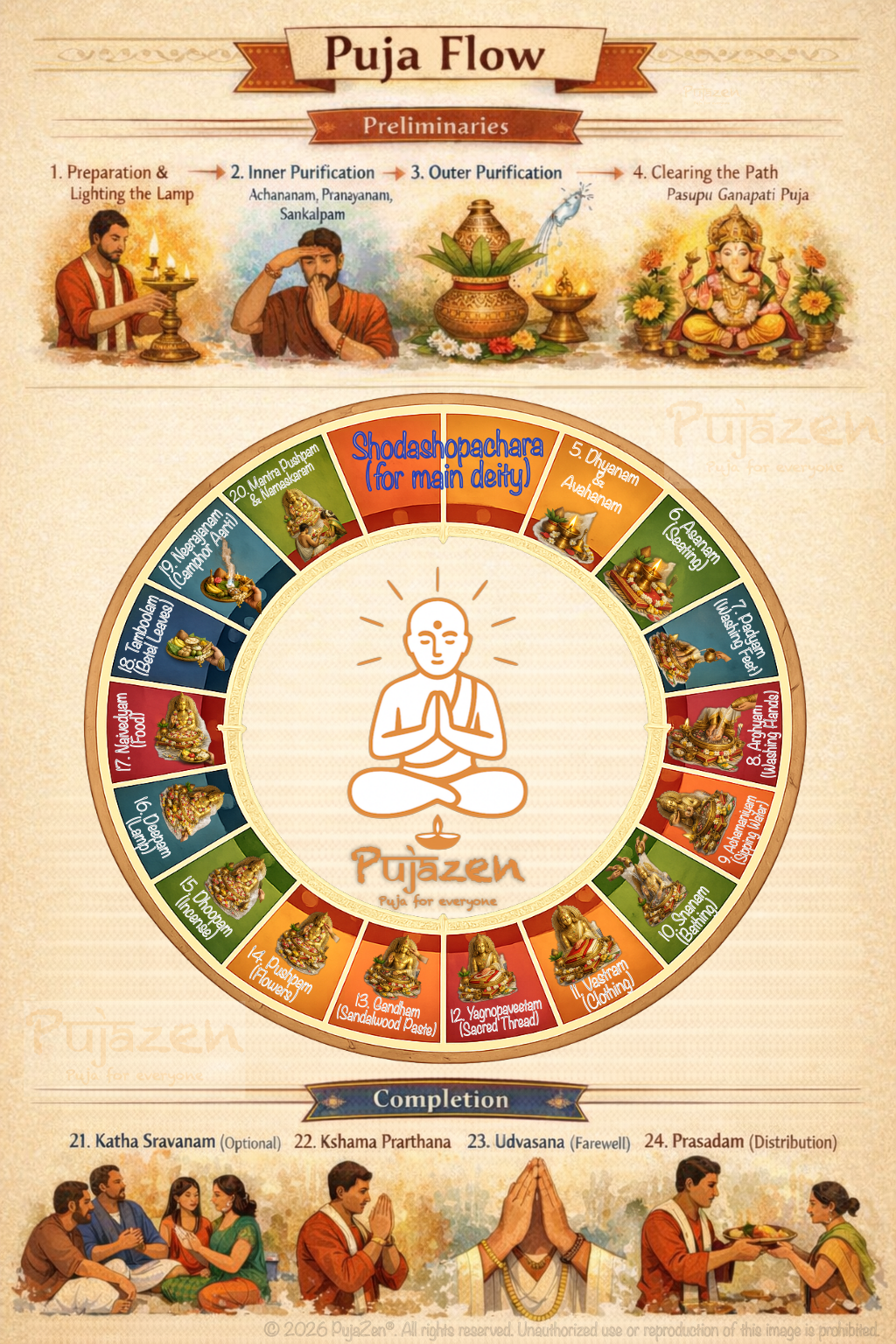
Pujas share a core sequence. We first prepare our mind and space, then perform an abbreviated ritual for Lord Ganesha, and finally perform the Shodashopachara (16 Royal Offerings) for the main deity. Think of it as formally welcoming a highly honored guest.
0) Preparation & Lighting the Lamp (Deeparadhana)+−
Laying out items keeps your attention focused. Before chanting begins, we light the main lamp (Deeparadhana) to invite the light of knowledge and the presence of the divine into the space.
1) Inner Purification (Achamanam, Pranayamam, Sankalpam)+−
- Achamanam & Hand Washing: We sip water three times to purify the body, mind, and soul, immediately followed by washing our hands.
- Pranayamam: Controlled breathing exercises to calm the nervous system and draw the wandering mind inward.
- Sankalpam: We declare our exact intent, stating our name, lineage, the cosmic date, and the specific reason for the puja.
2) Outer Purification (Kalasha, Ghanta & Prokshanam)+−
- Kalasha Puja: We invoke sacred rivers into a vessel of water, charging it with divine energy.
- Ghanta Nadam: Ringing the bell drives away negative energies and invites the divine presence.
- Prokshanam: We sprinkle the charged Kalasha water over ourselves and the puja materials to spiritually sanitize the physical space.
3) Clearing the Path (Pasupu Ganapati & Cosmic Forces)+−
- Ganesha Puja: We worship Lord Ganesha in a turmeric cone to remove all physical and mental obstacles.
- Navagraha & Dikpalaka (Optional): In larger pujas, we honor the Nine Planets and the Guardians of the Directions to harmonize cosmic forces before the main event.
4) Welcoming & Washing (Shodashopachara: Steps 1-6)+−
- 1. Avahanam: Visualizing and explicitly inviting the deity into the idol.
- 2. Asanam: Offering a comfortable, honored seat.
- 3. Padyam: Offering water to wash their feet.
- 4. Arghyam: Offering water to wash their hands.
- 5. Achamaniyam: Offering pure water for them to sip.
- 6. Snanam: Offering a refreshing bath (often using Panchamrutha), followed by pure water.
5) Adornment (Shodashopachara: Steps 7-10)+−
- 7. Vastram: Presenting fresh garments or cotton threads.
- 8. Yagnopaveetam: Offering the sacred thread of purity.
- 9. Gandham: Applying cooling sandalwood paste.
- 10. Pushpam (Ashtottara): Adorning with flowers while chanting their 108 names. Chanting names is a meditation on the virtues we wish to embody.
6) The Sensory Feast (Shodashopachara: Steps 11-14)+−
- 11. Dhoopam (Incense): Represents burning away worldly desires to leave only the fragrance of devotion.
- 12. Deepam (Lamp): Represents the light of knowledge dispelling ignorance.
- 13. Naivedyam (Food): Offering a meal to acknowledge God as the ultimate provider.
- 14. Tamboolam (Betel Leaves): Offered to aid digestion and sweeten the breath, completing the hospitality cycle.
7) The Grand Finale (Shodashopachara: Steps 15-16)+−
- 15. Neerajanam / Harathi: Waving burning camphor. It burns without a trace, symbolizing the total dissolution of the ego.
- 16. Mantra Pushpam & Namaskaram: A final flower offering with Vedic chants, followed by circumambulation (Pradakshina) and bowing down in complete surrender.
8) Completion (Katha & Kshama Prarthana)+−
For Vrats, we now listen to the sacred story (Katha) to ground the ritual into moral lessons.
Finally, we perform Kshama Prarthana. Because we are human and bound to make mistakes, we humbly ask for forgiveness, bid the deity farewell (Udvasana), and distribute the blessed food (Prasadam).